Black Hole Spectroscopy
Jaime Redondo-Yuste
Princeton University
Leinweber Institutes Postdoctoral Fellows Meeting
MIT  ·  22 October 2026
with E. Berti, B. Bucciotti, V. Cardoso, G. Carullo, M. Cheung, R. Emparan, K. Fransen, R. Ghosh, A. Green-Salinas, A. Kuntz, L. Lehner, D. Pereñiguez, J. Ripley, S. Yi, Z. Zhong

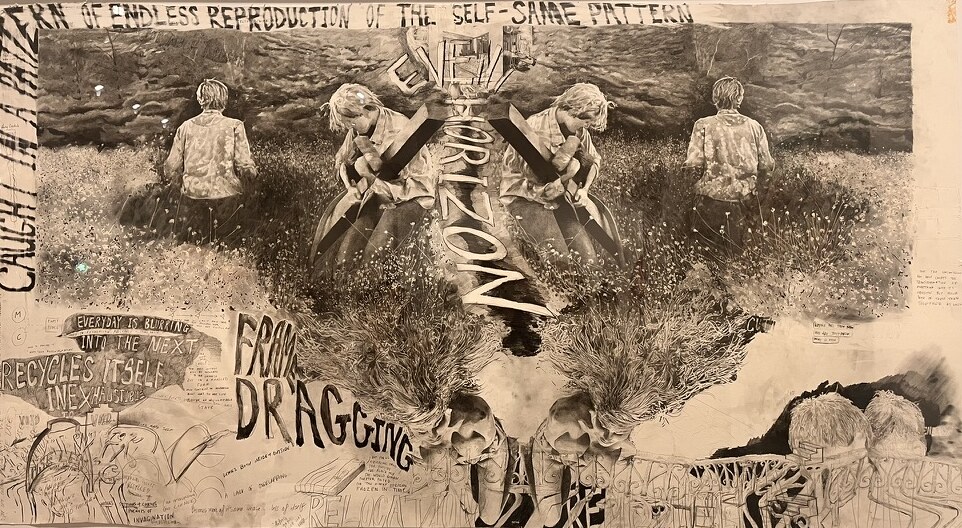
Kaari Upson, Event Horizon (2017): two mirrored figures in a field, the words EVENT HORIZON and FRAME DRAGGING lettered across it Kaari Upson, Event Horizon, 2017  ·  graphite, ink and gesso on paper
xkcd 1680, Black Hole xkcd 1680
How do black holes evaporate?
Is the geometry really Kerr?
Do horizons exist?
How does it ring
when you strike it?
Does gravity destroy
information?
Are black holes stable?
Can it be overspun,
or overcharged?
What is inside?
Does it have hair?
Do gravitational waves
scatter off each other?
$\ell = m = 2$ $3$ $4$
rewind
common horizon
final black hole
$g_{ab}$ $=$ $g^{\rm Kerr}_{ab}$ $+$ $h^{(1)}_{ab} + h^{(2)}_{ab} + \dots$
$h^{(1)}_{ab}$$\;=\; \sum_{\ell m} h_{\ell m}(t)\; {}_{-2}Y_{\ell m}(\theta, \phi)$
$h_{\ell m} \;=\; \sum_{n} A_{\ell m n}\, e^{-i \omega_{\ell m n} (t - t_{\rm mg})}$
$$h_+ - i h_\times = \sum_{\ell m n} \Big[\, A_{\ell m n}\, e^{-i\omega_{\ell m n}(t - t_{\rm mg})}\, \underbrace{{}_{-2}S_{\ell m n}(\theta, \phi)}_{\text{spheroidal harmonics}} \;+\; \underbrace{A'_{\ell m n}\, e^{\,i\omega^*_{\ell m n}(t - t_{\rm mg})}\, {}_{-2}S^*_{\ell m n}(\pi - \theta, \phi)}_{\text{mirror modes}} \,\Big]$$
$$h(t) = \sum_{k} A_k\, e^{-i\omega_k (t - t_{\rm mg})}$$
GR, spin $a/M = $
$M\omega_{220} =$
$M\omega_{440} =$
$M\omega_{221} =$
$A_k,\ \omega_k \in \mathbb{C}$ free.
Does the data support GR?
i.
Where we stand

GW150914

H1 data numerical relativity
SNR left after the cut
20.0
H1, normalised to the full 20; drop for white noise in band
GWOSC; LVK, PRL 116 061102 (1602.03837)

GW150914: one damped sinusoid

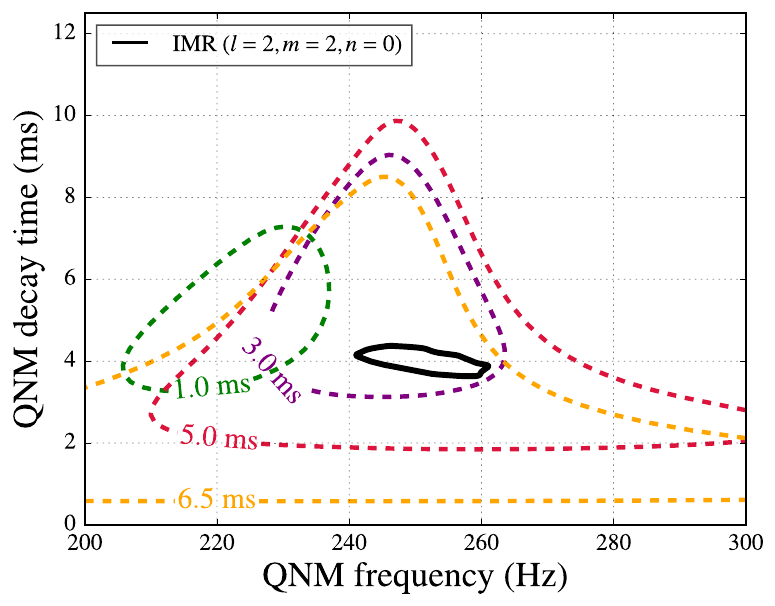
LVK: GW150914 single-mode ringdown posteriors in frequency and decay time for start times 1, 3, 5 and 6.5 ms after the merger, against the IMR prediction of the 220 mode LVK, PRL 116 221101 (1602.03841)

Data is messy

$t_0 = $ 0 $M$
one damped sinusoid, 50% / 90%
GR 220 and 221, from the full signal
Cheung & JRY (to appear)

Ten years later

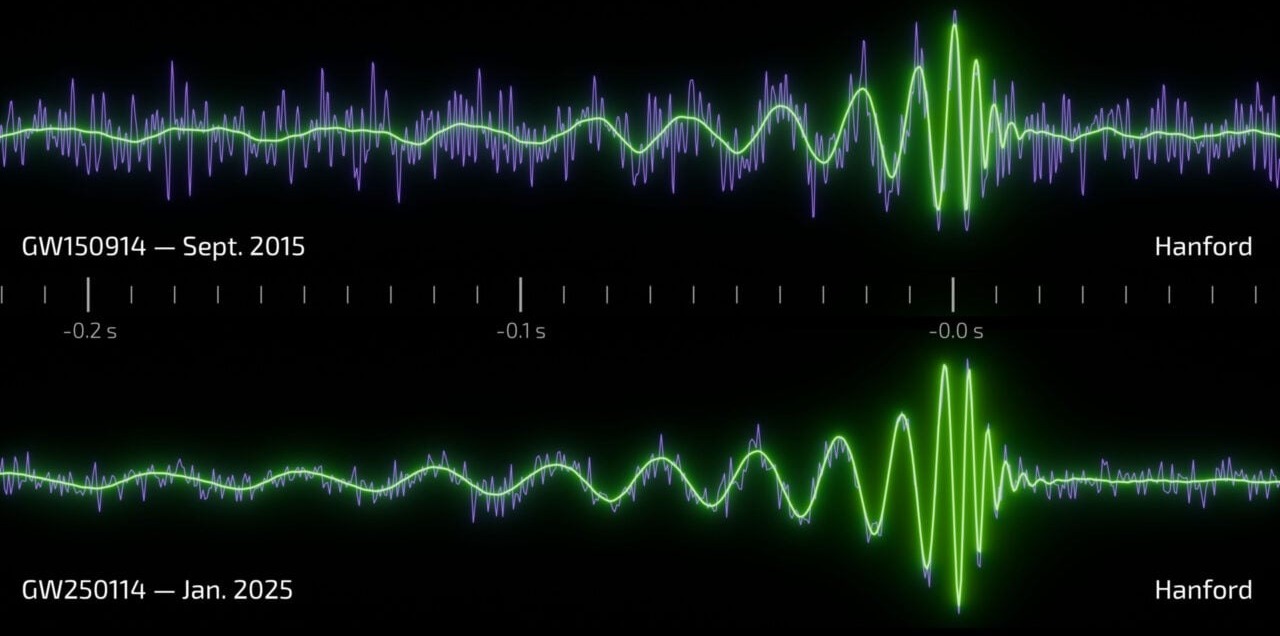
Hanford data and waveform for GW150914 (September 2015) and GW250114 (January 2025): the second is far louder above the noise LIGO / J. Tissino (GSSI) / R. Hurt (Caltech-IPAC)

GW250114: two analyses

LVK
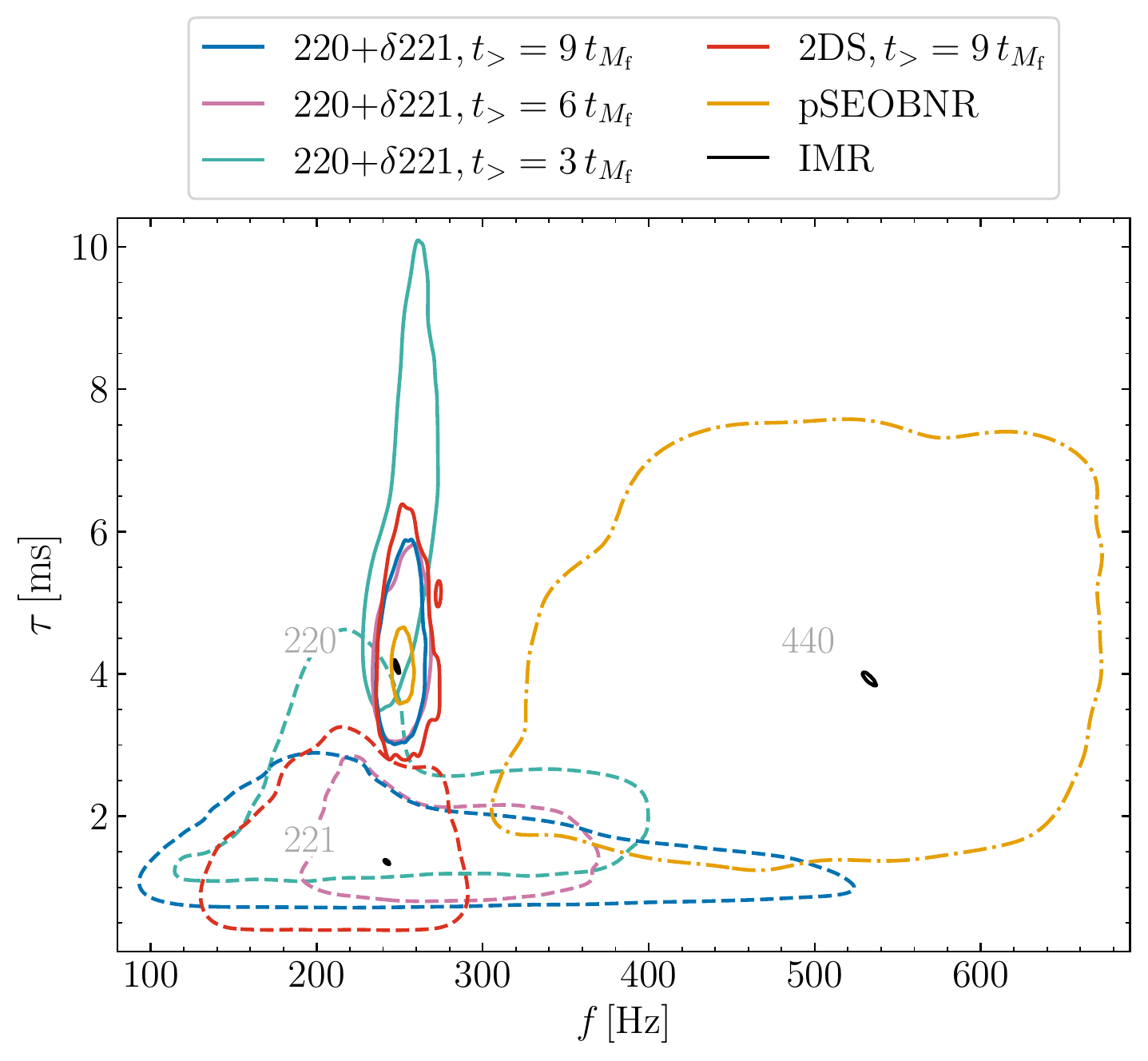
LVK: 90% regions of the 220 and 221 frequencies and damping times of GW250114 for several models and start times, against the IMR predictions LVK (2509.08099)
silencio, one modetwo modes, $t_0 =$ 0 $M$
Cheung & JRY (to appear)

The no-hair test

$f_{220}$
$\tau_{220}$
$f_{221}$
$\tau_{221}$
line: posterior median · band: 68%
Four measurements,
one Kerr black hole.
In black: the full signal (IMR).
bands: silencio, two modes at $t_0 = 6\,M$ (Cheung & JRY, to appear)
IMR: LVK data release (2509.08099)

Ten years of ringdowns

events

Stellar Graveyard

black holes neutron stars events, GWTC-1 to GWTC-5 with a ringdown analysis (LVK tests of GR)
ii.
What comes next

The next generation

Mock: GWOSC's NR waveform for GW150914 in white noise; the peak at 13.6σ as GW250114 in LIGO, ET taken 10× more sensitive near 250 Hz.

Gravity is nonlinear

$g_{ab} = g^{\rm Kerr}_{ab} + h^{(1)}_{ab} +$ $h^{(2)}_{ab}$ $+$ $h^{(3)}_{ab}$ $+ \dots$
$\mathcal{T}\big[h^{(2)}\big] = \mathcal{S}\big[h^{(1)}, h^{(1)}\big]$
Nonlinearities generate higher harmonics:
$\omega = \omega_{\ell_1 m_1 n_1} + \omega_{\ell_2 m_2 n_2}$
with an amplitude fixed by GR:
$A_{220\times220} = \mathcal{R}\, A_{220}^2$
At third order, the 220 meets itself twice:
$2\,\omega_{220} - \omega^*_{220} \approx \omega_{221}$

A new number to measure

Mitman+ 2022 2208.07380
Cheung+ 2022 2208.07374
Redondo-Yuste+ 2023 2308.14796
Cheung+ 2023 2310.04489
Zhu+ 2024 2401.00805
Bucciotti+ 2024 2405.06012
Khera, Ma & Yang 2024 2410.14529
Berti, Cardoso, Carullo+ (incl. JRY) (2505.23895)

Within reach of the next generation

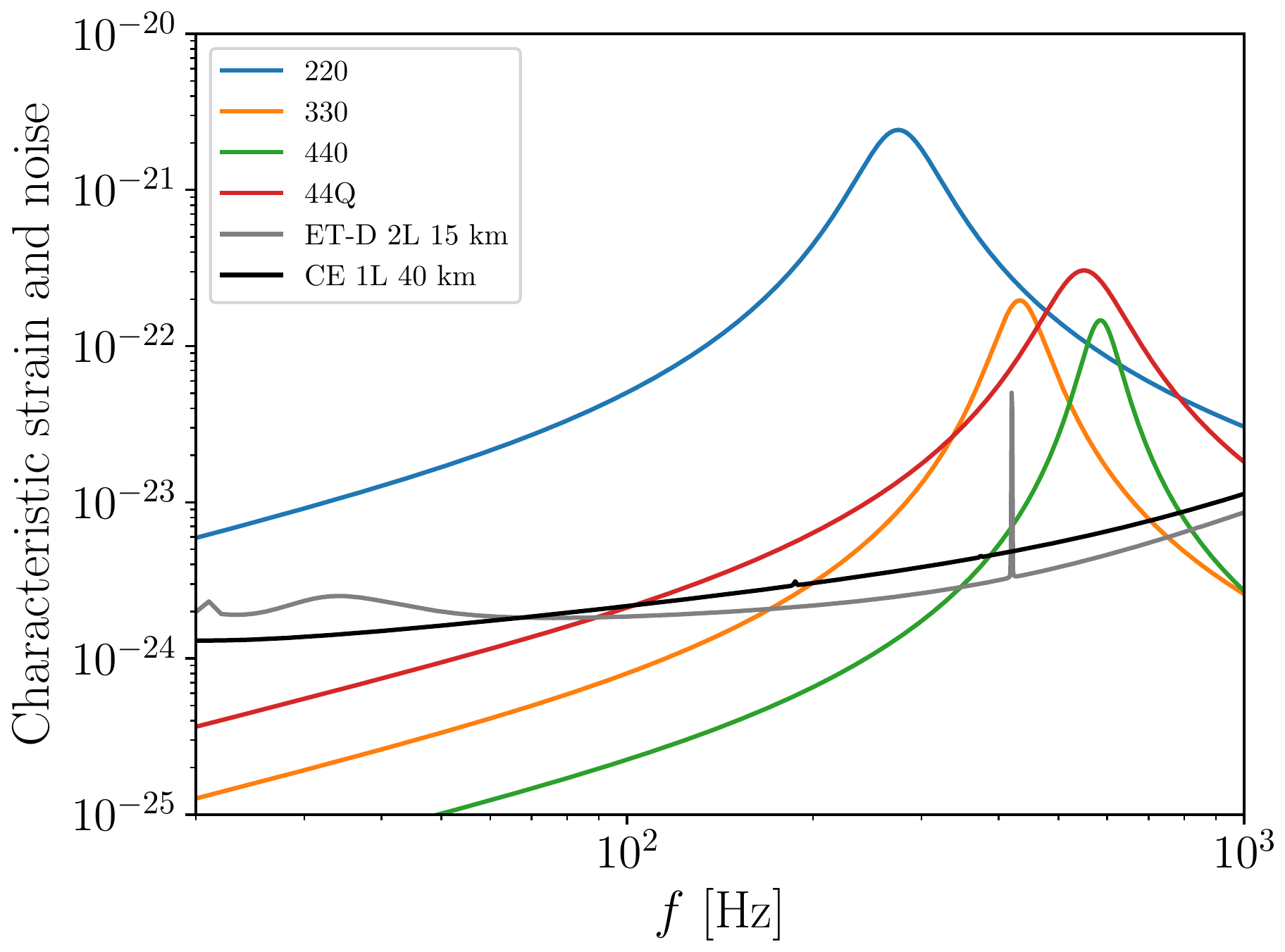
Characteristic strain of the 220, 330, 440 and quadratic 44Q modes of a GW150914-like event against the ET and CE noise: the 44Q lies above both noise curves and above the linear 440 Lagos, Andrade, Rafecas-Ventosa & Hui (2411.02264): a GW150914-like event
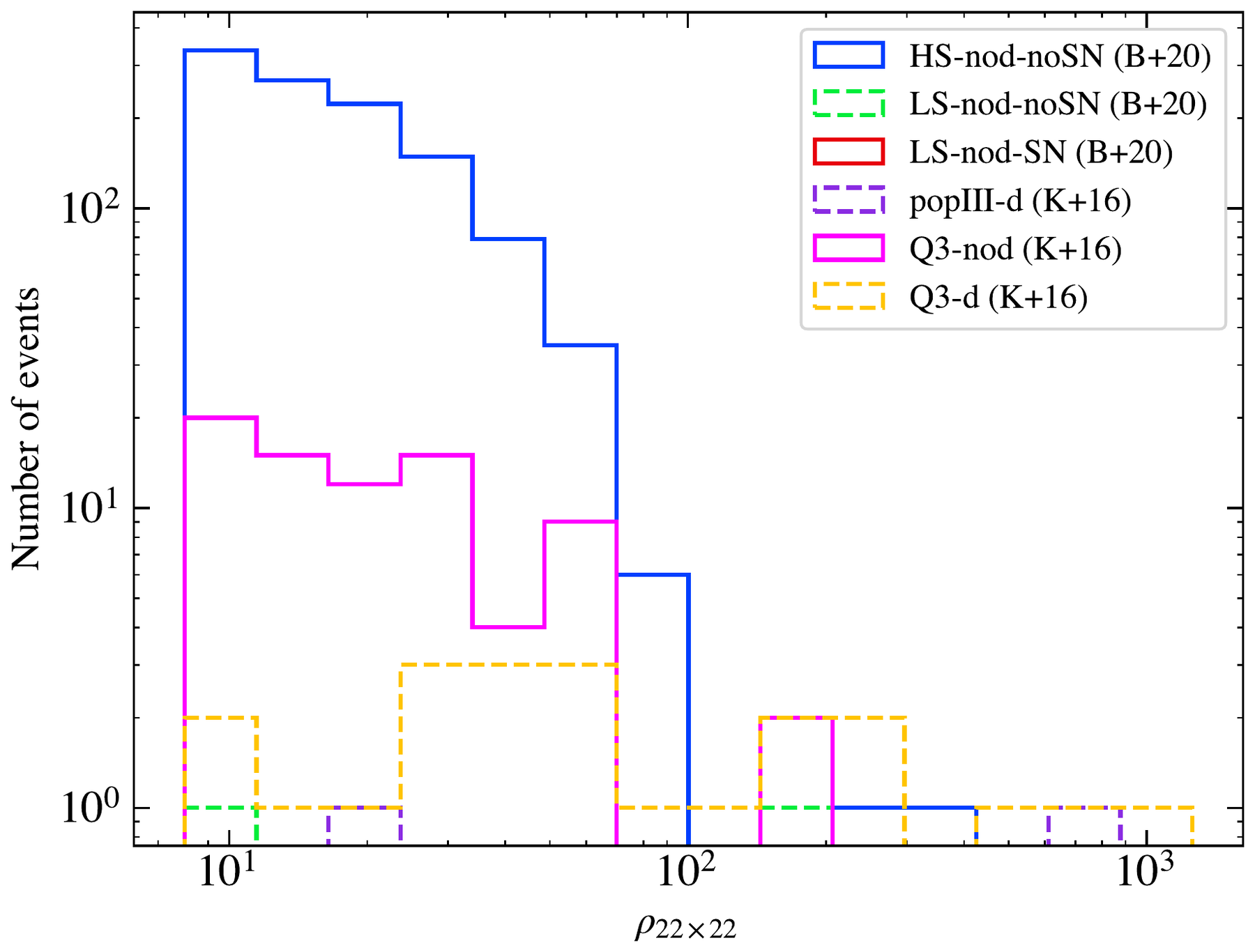
Number of massive black hole mergers in 4 years of LISA with a detectable quadratic mode, against its SNR, for several population models: hundreds above SNR 8 in the heavy-seed model, some above 100 Yi+ (2403.09767): LISA, 4 years, events with a detectable 22×22 mode

Black holes in the lab, on paper

i.Two waves in, one out: scattering at second order
$\mathcal{Q} = 0.1360 - 0.05715\,i$ for $(2,2,+) \otimes (2,2,+) \to (4,4,+)$
A 5-point Compton amplitude: the black hole's nonlinear response, computed exactly.
Bucciotti, Redondo-Yuste, Zhong, Kuntz & Cardoso (2609.20934)
ii.Third order: cubic QNMs
at 3M after the peak, the cubic part is ~38% of h₂₂
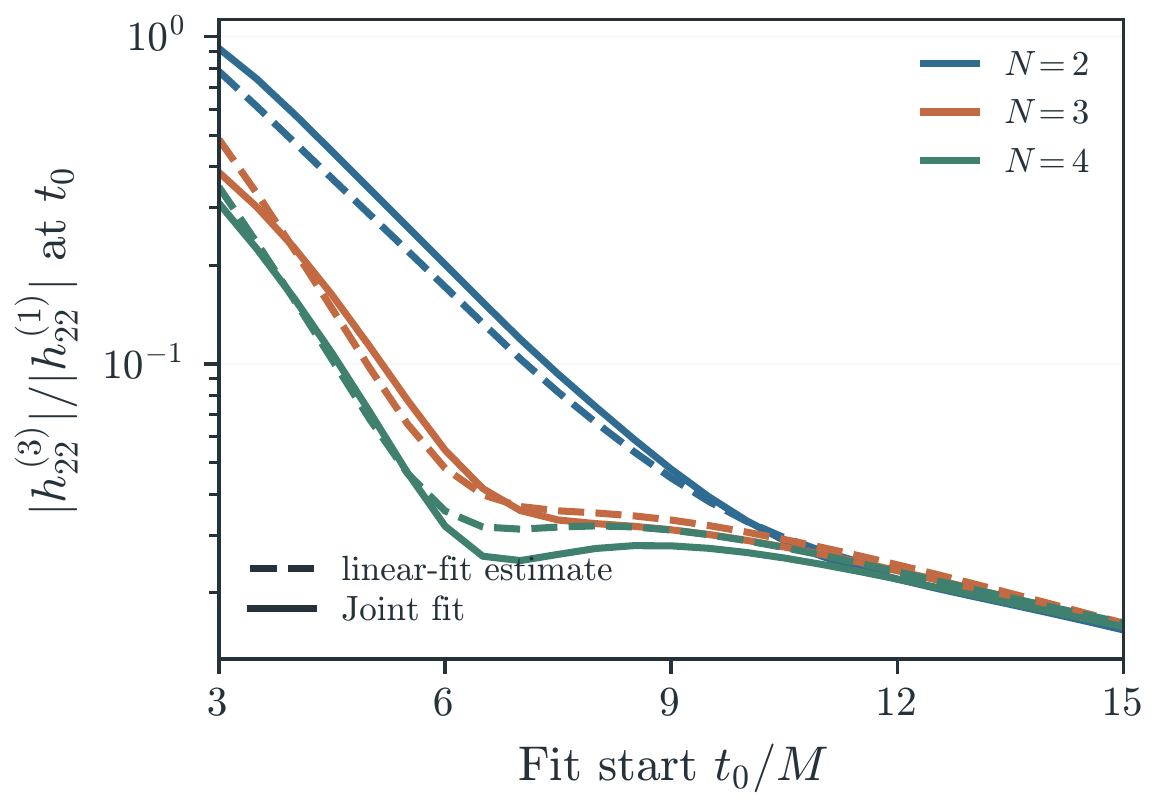
Ratio of cubic to linear h22 against fit start time, from about 0.9 at 3M down to about 0.02 at 15M Khera & Yang (2610.20547), last week

Higher orders, more charges

iii.Any order, analytically: the large-D limit
nonlinear modes improve the ringdown model by orders of magnitude
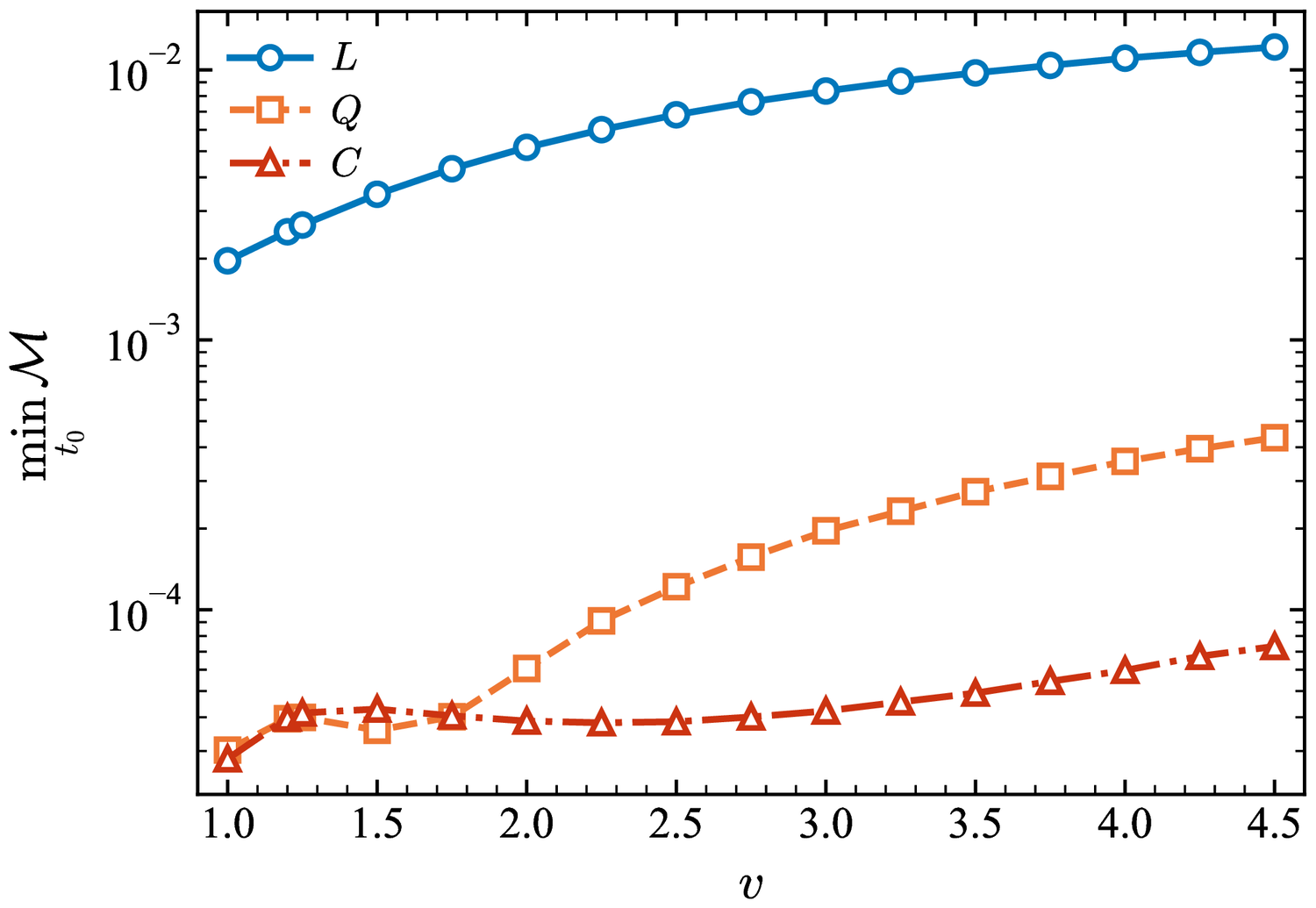
Log-scale plot of ringdown mismatch versus collision velocity for linear, quadratic and cubic quasinormal-mode models Emparan, Green-Salinas, Pereñiguez & Redondo-Yuste (2606.23804)
iv.Second order with charge: Kerr–Newman
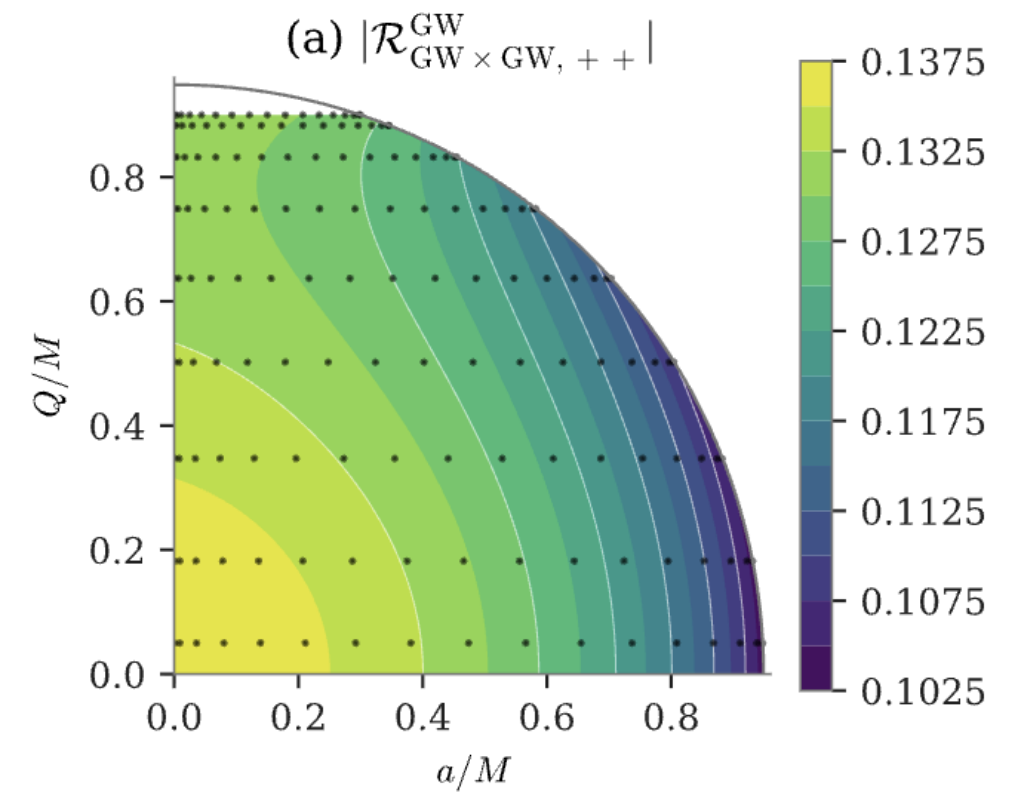
The quadratic ratio over spin and charge for Kerr-Newman black holes: from about 0.137 at small spin and charge down to about 0.10 near extremality ongoing work: near extremality, computed, and stored safely on Anvil…
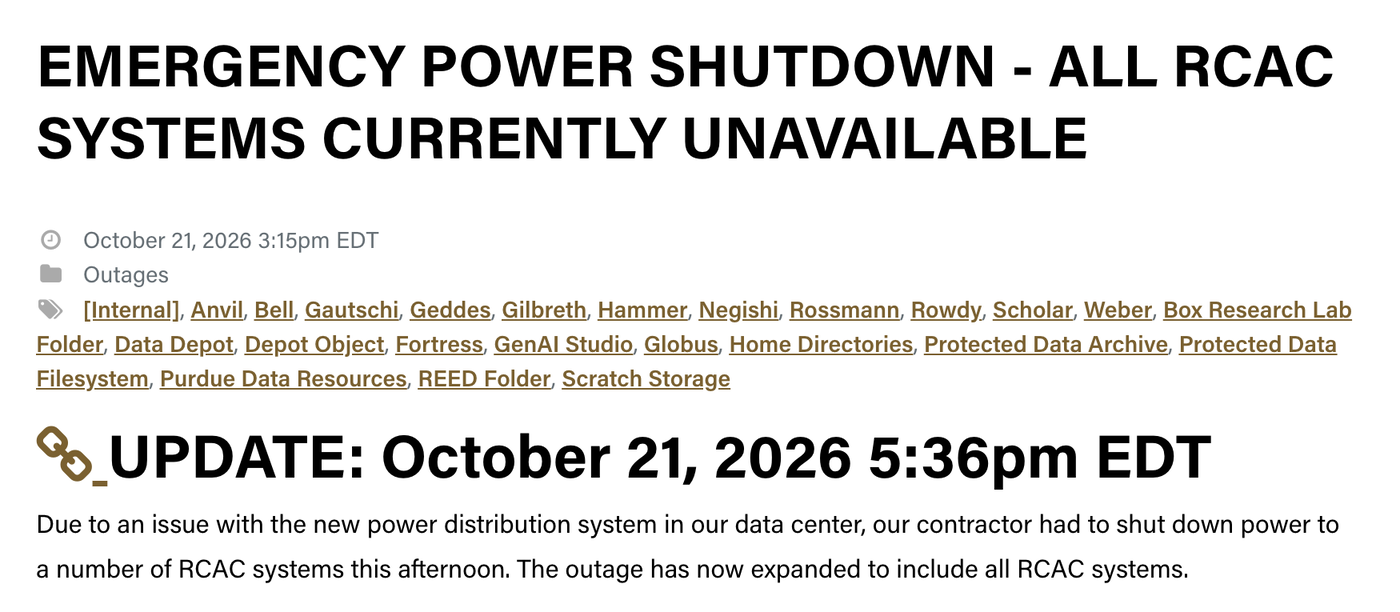
Purdue RCAC notice, 21 October 2026: emergency power shutdown, all RCAC systems currently unavailable, Anvil among them rcac.purdue.edu, yesterday

Louder signals: challenge and opportunity
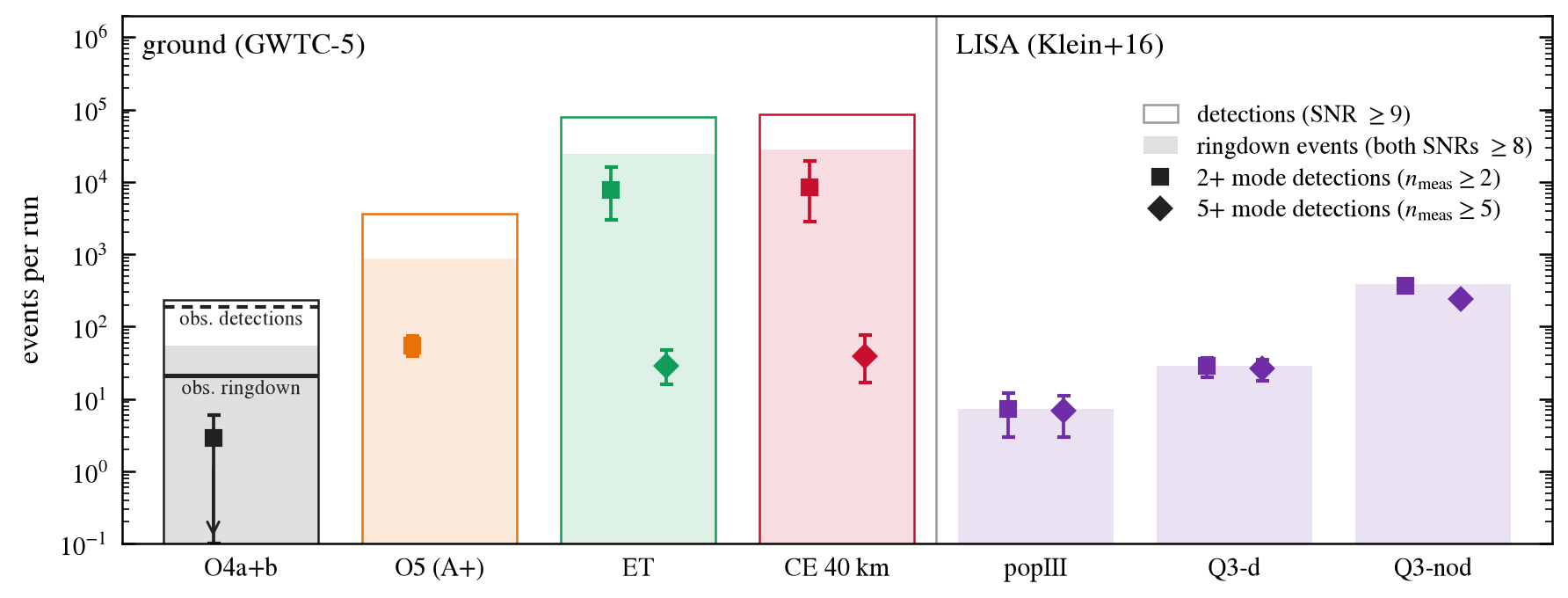
Events per run on a log scale for O4a+b, O5, ET, CE 40 km and three LISA populations: detections, ringdown events, and events with 2 or more and 5 or more measured modes; ET and CE reach about ten thousand events with 2 or more modes Redondo-Yuste & Yi (to appear)
1ET, CE: ~10⁴ multi-mode events, and O(10) events with many modes in LISA
2Systematics take over: unmodelled overtones, tails, the prompt response
3We need black hole spectroscopy beyond quasinormal modes

Conclusions

  • Black hole spectroscopy can test the nature of black holes
  • Data is picking up: expect dramatic improvements in 10–20 years
  • Will GR pass the test? The devil lies in the next decimal place
  • Nonlinearities, nonmodal effects and data systematics are the challenges ahead
Is the geometry really Kerr?
How does it ring when you strike it?
Are black holes stable?
Does it have hair?
Do gravitational waves scatter off each other?
Do horizons exist?
Can it be overspun, or overcharged?
How do black holes evaporate?
Does gravity destroy information?
What is inside?